The M1 Garand’s En Bloc Clip: A Small Device with a Long Public Memory
4 min read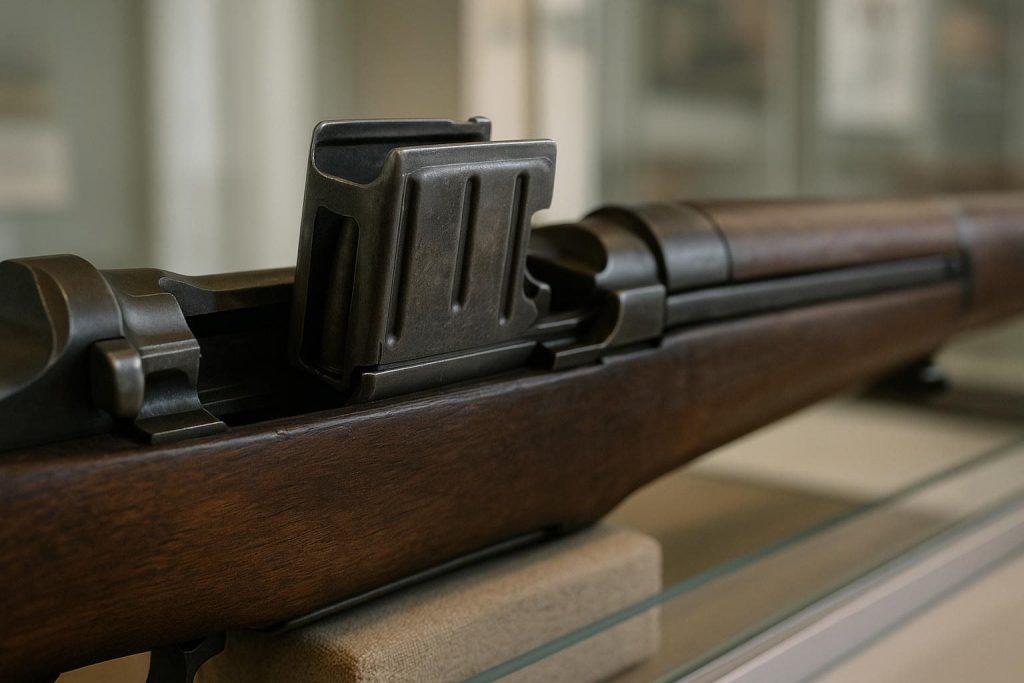
The En Bloc Clip: A Key Component of the M1 Garand
A soldier with the M1 Garand followed a loading routine. Than feeding one cartridge at a time he inserted an eight‑round en bloc clip straight into the receiver. The en bloc clip was the heart of the loading system letting the soldier fire quickly again. When the last round was fired a sharp metallic ping announced the ejection of the en bloc clip and that ping became a hallmark of the M1 Garand that still echoes in soldiers' memories.
Challenges in Designing a Modern Rifle
The U.S. Military wanted a self‑loading rifle that could outpace the old Springfield bolt‑action. The aim was more than faster shooting; it was to build a rifle that would stand up to hard use be easy to carry simple to supply and cheap to make in large numbers.
Detachable box magazines looked promising. They had problems. Troops would have to lug boxes and change how they handled ammo. John C. Garand chose a path: a fixed internal magazine that fed from the top and used an eight‑round metal clip. This way the loading system was built into the rifle. The clip would leave the firearm after the round, a special trait that set the M1 apart from rifles that used loose rounds or detachable magazines.
The Impact of a Small Component
The en bloc clip was more than a loading tool. It shaped the M1 Garand's design: how many rounds it could hold, how wide the receiver opened and the sounds it made. A museum display might show the stock and the steel barrel yet if the en bloc clip were missing the story of the M1 would be unfinished.
That tiny clip also shows how facts can differ from stories. The familiar ping that rings when the clip leaves is real. The tale that foes used that ping to find a soldier's weak spot is more complicated. In battle tough truths are often turned into tales that do not always hold true.
Seeing this nuance helps us read history more correctly. The en bloc clip's sound tells us how important it was in life while also reminding us that each fight is different.
The M1 Garand in Action
The U.S. Army put the M1 into service before World War II. It became the main rifle during that war and later in Korea.. The rifle's worth was not just in its specs. Troops had to learn how to load and keep the M1 working in conditions because it worked differently from many enemy guns.
The en bloc clip gave the M1 a trade‑off. It made loading strong. Self‑contained, but it could not change how many rounds were ready as fast as a detachable magazine could. In the field soldiers balanced these facts-speed, weight, reliability and ammo supply-to fit their mission.
When museums try to teach they should show this link. Rather than call the rifle powerful' or 'advanced ' they can ask visitors what the loading system let soldiers do and what it forced them to do. Exploring these ideas turns the M1 from a display piece into a weapon of war.
The Legacy of the En Bloc Clip
The M1 Garand's legacy did not force every rifle to copy its loading. After the war designers moved toward rifles with box magazines. The M14 is an example: it took some ideas from the M1. Used a different way to feed ammo.
This shows a lesson about how tech changes. Good features are often taken in pieces, not copied whole. A newer rifle might keep a system or a special build method but not use the original's full loading system.
Seeing this line of models explains how weapons grow. A new rifle is not a better version that makes the old one useless. The M1 is still a point in gun history because it solved many hard problems even though its exact loading way did not carry on.
Interpreting History, in a Context
In Western North Carolina, rifles and their parts, such as the en bloc clip often find their way onto museum displays, veteran exhibitions or into personal family stories. It is essential to dig than simply naming a weapon. One must also consider how the en bloc clip and other components connect to the people and events they honor.
A physical match can give insight into what model a weapon's how it was meant to be used but it cannot prove the history of ownership. To establish provenance researchers might look at service records, photographs, letters or family documents each with levels of reliability. Thoughtful labels should draw a line between documented history and folklore to ensure accurate representation.
The careful approach also applies to memorials. An M1 Garand can represent service, the industrial strength of a generation or the unique story of a single veteran. While these meanings often overlap they are not the same. Deeper understanding comes from recognizing the stories that shape the context around an object rather than letting one item symbolize the experience of all soldiers.
Ultimately the en bloc clip is an entry point, into the intertwined stories of engineering and memory. It shows how loading mechanisms work. Guides us through the details of production and combat connecting us to the larger narrative of remembrance that modern viewers help keep alive.